
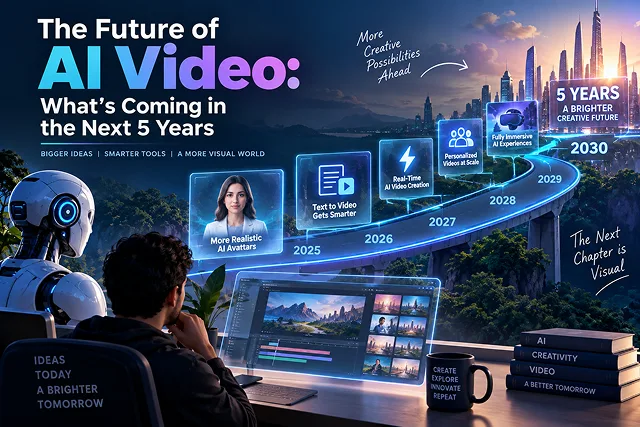
AI video has grown out of early generative diffusion technologies known for producing scary, otherworldly morphs. Early models had continuity problems, didn’t follow laws of anatomy, and didn’t respect physics principles. Now, the industry has established scalable video foundation models that are able to produce a film-like video of 4K quality, with realistic fluid dynamics and strict spatiotemporal continuity.
In the next five years, AI video will develop from independent novelties relying on text prompts to real-time spatial simulators and multimodal neural rendering systems.streaming technologies.
Feature Matrix: Generative AI Video Today vs. Next 5 Years
Technology Roadmap Matrix · Current State of the Art vs. Next 5-Year Horizon
| Technological Capability | Current State (State of the Art) | The Next 5-Year Horizon (Projected Maturity) |
|---|---|---|
| Clip Duration & Memory | 5 to 15 seconds per generation (Requires manual timeline stitching) | Infinite temporal coherence (Native multi-scene narrative memory & scene continuity) |
| Physics & Object Permanence | Approximated via 2D latent frames (Occasional warping on rapid occlusions) | True 3D world-model simulation (Rigid-body dynamics, volumetric fluids, collision math) |
| Camera & Director Control | Text prompts + rough camera trajectories (Dolly, Pan, Orbit) | Sub-pixel 6-DoF trajectory mapping, virtual lens rigs, & real-time re-lighting |
| Multimodal Synthesis | Independent models for audio, lip-sync, and visual frames | End-to-end unified multimodal transformers (Joint generation of visuals, Foley, score, & dialogue) |
| Rendering Latency | Asynchronous batch compute (30s to 3 mins per clip) | Real-time 60+ FPS interactive neural rendering (Sub-100ms latency on edge & cloud) |
| Post-Production Editing | Mask-based inpainting & manual composition layers | Semantic natural-language re-shooting ("Change actor's coat to green wool and shift lighting to sunset") |
1. Core Architectural Pillars Shaping the Next 5 Years
[Master Semantic Script / Prompt]
                │
                ▼
[Hybrid World Foundation Model]
    ├── Physics Simulator (Gravity, Momentum, Particle Fluidics)
    ├── 4D Volumetric Space (Dynamic Gaussian Splats)
    └── Multi-Camera Spatio-Temporal Consistency Engine
                │
                ▼
[Real-Time Latent Edge Streaming] ➔ 60 FPS Native Playback with Zero Encoding Latency
                │
                ▼
[Personalized Dynamic Render] ➔ Viewer controls camera angles, character arcs, and lighting
1. From Video Generators to Physical World Models
- Early video generators only mimicked pixel patterns: they generated water that looked like water, but did not understand displacement, buoyancy, or viscosity.
- By the time we reach the latter part of the 2020s, video models will begin to function as complete "World Models". For any AI-generated video of a car drifting through a turn, the system will calculate tire friction, road damp, centrifugal force, and suspension compression before rendering the video pixels. In this way, generative video will effectively turn into an empirical simulation tool for the purposes of autonomous driving or robotics, as well as building testing.
2. Multi-View Volumetric Creation (4D Gaussian Splatting)
- Traditional video output is flat: Conventional video productions have a simple two-dimensional appearance with their fixed arrangement of 1920×1080 pixels or 3840×2160 pixels captured from a single, predetermined perspective.
- The future of video is volumetric: Models synthesize dynamic 4D scenes using Gaussian splatting or continuous radiance fields. Directors and audiences will render a scene once, then position cameras anywhere in the 3D space in post-production, pull arbitrary rack focuses, or step into the scene directly via spatial computing headsets.
3. Hyper-Personalized, Infinite Tree of Choices
Streaming distribution will decouple from fixed static video files. Instead of Netflix streaming a single pre-rendered MP4 stream across a CDN, future media delivery will involve real-time client-side neural rendering:
- Dialogue, background lighting, and pacing adjust in real time to viewer engagement signals.
- Viewers select branching narrative choices where characters, scenes, and environments generate instantaneously on the fly.
- Localized cultural settings, background signage, and spoken native languages render synchronously with no dubbing artifacts.
2. The 5-Year Industry Production Sequence
For production houses, developers, and creators, adapting to this shift requires modernizing operational pipelines across five critical stages:
1. Consolidate Character LoRAs and Identity Anchor Vaults
- Replace ad-hoc prompt experiments with deterministic, seed-locked character models using IP-Adapter, ControlNet, and custom-trained LoRAs. Establish unified asset repositories to ensure actors and brand identities remain identical across multi-shot sequences.
2. Integrate 3D Spatial Rigs with Diffusion Processes
- Use hybrid production tools: matrix real time engines (such as Unreal Engine 5 or Blender) to block out type of complex action, camera movements, and scene geometry before using neural video passes to create lifelike lighting, skin textures, and atmosphere on top of the 3D wireframe geometry.
3. Implement Low Latency Neural Edge Solutions
- Transition from cloud queue batch renders to edge NPU inference. Build sub-second automated video pipelines that ingest live user prompts, database metrics, or sensor telemetry and output responsive video streams at 60 FPS.
4. Publish Free-Viewpoint Interactive Experiences
- Deliver media as volumetric scene packages rather than flat, single-angle video files. Allow viewers to navigate scenes in 3D space, interacting with responsive characters through multimodal speech and vision models.
Five-Year Evolution Trajectory: 2026 to 2031
The transition of neural video models follows five distinct evolutionary phases across compute architecture, interaction, and infrastructure:
| Evolution Phase | Primary Technical Architecture | Core Industry Breakthrough | Main Consumer/Enterprise Impact |
|---|---|---|---|
| Phase 1: Cinematic Coherence | Spatio-Temporal Transformers & High-Density Flow Matching. | Multi-minute temporal stability, precise hand/anatomy dynamics, zero frame drift. | Rapid production of commercials, short-form reels, and digital brand explainers. |
| Phase 2: World Simulators & Physics Engines | Latent Diffusion paired with Neural Physics Prior Networks. | True understanding of gravity, fluid kinematics, reflection, and material mass. | Synthetic training data for robotics and hyper-realistic automated product testing. |
| Phase 3: Real-Time Interactive Streaming | Autoregressive Latent Predictors running on Edge NPUs. | Sub-100ms latency generation (60 FPS interactive video feeds). | Real-time adaptive gaming worlds, conversational video assistants, and live avatar calls. |
| Phase 4: Volumetric 3D / 4D Gaussian Splatting | Radiance Fields (NeRFs) merged with Dynamic Diffusion Splats. | Free-viewpoint navigation—render once, explore from any camera angle. | Immersive XR/VR headsets, virtual film sets with infinite depth re-shooting. |
| Phase 5: Fully Autonomous Hollywood Pipelines | Agentic Orchestration connecting Voice, Script, Motion, and VFX. | Complete 90-minute multi-scene feature films compiled from master scripts. | Democratized indie studio production; hyper-personalized viewer-directed narratives. |
Request A Custom AI Video
Tell us what you're trying to create and we'll point you to the right tool — or help you set it up.
3. Stepwise Strategic Roadmap: Getting Ready for the Future of AI Video
In order to remain ahead as these technologies advance, creators, marketing professionals, and production houses need to modify their work processes. Use this phased 5-stage preparation plan:
1. Transition from Adjective Fluff to Cinematic Syntax
- Stop using vague and clichéd terms (such as "photorealistic, 8K masterpiece"). Rather, get familiar with the words pertaining to cinematography (focal length of the lens, types of lighting, movement of the 3D camera). Video engines will increasingly demand technical directorial commands over vague aesthetics.
2. Adopt a Modular, Multi-Tool Production Pipeline
- The future belongs to creators who understand how specialized neural layers interact:
3. Establish Clean Character Bibles & Digital Provenance
- Future studio pipelines will require 100% actor and style consistency. Build "Character Bibles" containing multi-angle reference portraits, voice embeddings, and custom LoRA checkpoints. Implement cryptographic media authentication (C2PA metadata manifests) to ensure brand transparency and compliance with evolving synthetic media regulations.
4. Design Dynamic and Interactive Content Types
- Begin architecting video content with branching logic. Learn how streaming personas and video hooks in real time are responsible for modifying messages based on viewer engagement, their positioning, or any messages received in the course of live chats.
5. Update Video Compression and Delivery Systems
- With the rise of the production of video, the importance of bandwidth efficiency is steadily increasing. Learn how to control the rate of perception by neural means, understand the changes in space upscaling and learn about various codecs such as AV1 and H.265/HEVC.
4. Economic, Ethical & Regulatory Environment
As generative video technology advances to the point where it is visually indistinguishable from live-action video, three foundational hurdles now face the industry:
Rules for Punctuation in Voice Engines
- Provenance Cryptography & Watermarking: The increasing adoption of standards such as C2PA (Content Authenticity Initiative) will lead to mandatory use in enterprise distribution. Hardware- and model-level cryptographic signatures check for authenticity in video frames, i.e., if they are real, synthetic, or altered.
- Actor Likeness Licensing & Synthetic Royalties: Current contracts for actors clearly delineate the rights to the use of a person’s likeness in a digital setting to the right to a physical performance. Automated smart contracts and fractional licensing platforms will distribute royalties each time an actor's synthetic persona is rendered in brand campaigns or gaming titles.
- Compute Economics and Edge Silicon: Multi-minute 4K videos created in data center facilities are high-cost, compute-intensive operations. In the coming five years, Neural Processing Units (NPUs) allowing for most inferencing work to be done on mobile, desktop, and smart TV hardware should bring down cloud egress costs and latency.
5. Key Challenges Facing Industry
- Compute & Energy Infrastructure Limitations: Development and implementation of AI video models will warrant considerable electricity and high-bandwidth memory. The advancement of this technology relies on the availability of efficient hardware solutions, high-capacity optical interconnects, and successful model quantization.
- Copyright Issues, Provenance, and Licensing Process: As video technologies improve and replicate famous actors’ appearances and directorial techniques, legal aspects such as consent to use data for training, fair use, and synthetic publicity rights will become relevant.
- Authenticity Verification Dilemma: The democratization of motion picture production will make the process of differentiating between real and fake media products extremely complicated. Implementing cryptographic watermarking, hardware-based camera signing, and C2PA open standards will be essential for corporations.
The Future of AI Video: Next 5 Years
Explore world models, real-time interactive simulation, neural physics, multimodal director engines, and synthetic cinema.
The shift from 2D pixel hallucination to true 3D World Models. Today's generative engines predict how pixels move across a flat canvas. Over the next five years, video models will construct persistent three-dimensional virtual environments with internal physics, object permanence, and temporal memory—allowing cameras to move anywhere inside a generated scene without visual warping or geometry breakdown.
By 2030, solo creators and indie studios will be capable of producing 90-minute theatrical-grade films on desktop hardware. However, mainstream cinema will adopt AI as a ubiquitous co-pilot rather than a replacement for human vision—using generative layers for virtual set creation, digital stunts, seamless aging/de-aging, and instantaneous background crowd simulations while preserving human directorial narrative control.
We will transition toward Zero-Latency Interactive Media. Instead of transmitting pre-encoded MP4 files over content delivery networks, video feeds will be rendered on the fly at 60+ frames per second based on user interaction. Viewers will be able to change camera angles during a live broadcast, alter the narrative path of a drama in real time, or step inside the video environment using mixed-reality headsets.
Next-generation engines are incorporating Differentiable Physics and Neural Navier-Stokes Solvers directly into model latent spaces. Rather than merely memorizing what pouring water looks like, the neural network learns real-world physics laws—accurately simulating gravity, fluid viscosity, kinetic collisions, and cloth friction without melting fingers or unnatural floating artifacts.
Today, creators chain separate models for video, voiceover, music, and foley sound effects. Future systems will feature Single-Pass Omnimodal Synthesis: entering a prompt will synthesize the visual scenes, synchronized spatial audio, dialogue with micro-lip timing, room reverb acoustics, and background score simultaneously from one unified neural foundation.
Typing text prompts into a blank box will be considered a legacy method. Future workflows will rely on Spatial Director Interfaces. Creators will use virtual 3D camera rigs, set lighting keyframes in spatial coordinate systems, sketch motion trajectories with styluses, and direct digital actors using voice commands like a live film set (e.g., "Actor A: walk slower and look surprised on step three").
Commercials will evolve from static broadcast clips into Context-Aware Dynamic Video Streams. Brands will deploy a single campaign core, and the AI model will render tailored visual variations in real time based on the viewer’s local weather, regional architecture, preferred color aesthetics, and primary language, lifting viewer conversion rates dramatically.
Advancements in Dedicated Neural Processing Units (NPUs) and Model Quantization (1-bit / 2-bit weights) will move heavy generation off centralized cloud data centers and directly onto consumer laptops and smartphones. Generating high-definition 4K video clips locally without subscription fees or cloud latency will become standard by 2028–2030.
Hardware-enforced Cryptographic Signatures (C2PA) and Invisible Watermarking (SynthID) will become mandatory on all social networks and web browsers. Any video without a verified cryptographic provenance tag will be flagged automatically as unverified or synthetic, while digital likeness registries will protect actors' voices and faces under universal commercial licensing statutes.
Focus on timeless creative fundamentals: Storytelling, Visual Pacing, Art Direction, and Pipeline Automation. As pure generation tools become commoditized utilities, the technical barrier to rendering high-definition video will drop to zero. The ultimate differentiator will be taste, unique intellectual property, coherent worldbuilding, and mastery over hybrid multimodal editing workflows.
Ready to try Skora AI?
Transform your ideas into cinematic video in seconds.