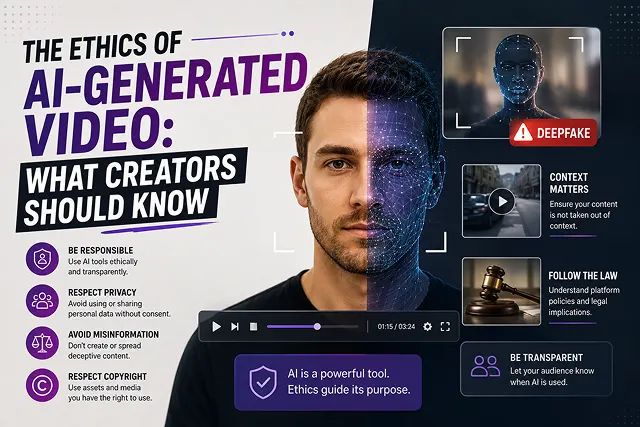
As generative video engines become both more sophisticated and easier to use, the distinction between real human footage and artificial media is becoming less pronounced. Content creators, website managers, and internet marketers are now busy dealing with the ethical implications of the use of AI-produced video material, as it will allow them to secure their channels and preserve the trust of their audiences and conform to the requirements getting revenue through the use of video content.
Hereinafter is a guide to understanding consent, disclosure, copyright compliance, and platform requirements in the age of synthetic videos.
Above-the-Fold Feature Matrix: Ethical vs. High-Risk Synthetic Media Practices
Synthetic Media Matrix · High-Risk Practices vs. Responsible Creator Benchmarks
| Ethical Dimension | High-Risk / Problematic Practice | Responsible Creator Standard (2026 Benchmark) |
|---|---|---|
| Consent & Identity | Cloning real individuals' voices/faces without explicit authorization | Strict Opt-In Consent: Verified legal contracts & talent waivers |
| Content Transparency | Distributing synthetic hyper-realistic media without disclosure | Multi-Layer Disclosure: Invisible C2PA metadata + clear on-screen tags |
| Copyright & Training | Scraper-based prompt cloning of living artists' signature styles | Ethical Style Prompting: Focus on lighting, camera vectors, & broad genre cues |
| Information Integrity | Generating synthetic news B-roll that misleads viewers on real events | Verification & Fact-Checking: Editorial review passes for factual claims |
| Platform Compliance | Attempting to bypass AI detection to trick search & social algorithms | Adherence to Platform Guidelines: Full compliance with YPP & ad policies |
1. Platform Policy Requirements & Disclosure Rules
Major platforms require content creators to disclose when video or audio has been generated or altered using AI:
- YouTube Declarations: According to the YouTube rule, content creators are required to check the box for "Altered or Synthetic Content" in the YouTube Studio for any real footage of a real person that may show them doing something that they never did, or any manipulated footage of real-life incidences. If they fail to disclose this, their content can be removed and they may face suspension from the YouTube Partner Program.
- Labeling on TikTok & Meta: On the platform TikTok, content created by popular AI systems is alerted automatically by the site, and it requires people to tag their content themselves with #AI. Whereas, Meta (Instagram/Facebook) identifies AI-created content based on C2PA technology and shows the "AI Info" sign for synthetic visuals.
- C2PA and Content Credentials: New generation technologies disseminate invisible marking and metadata extraction technique, C2PA, in the generated MP4 and WebM files.
2. Copyright, Fair Use, & Monetization Realities
It is imperative to be aware of the rules when dealing with copyright and monetization in synthetic video:
- Public Domain vs Copyright: As per most legal jurisdictions across the world, any totally automated content created without the help of a human being may not be subject to copyright. To avoid future issues, make sure a human being is somehow involved in script-writing, arranging the picture, working with colors, or producing the sound.
- Data Predicament: The problem here is your usage of explicit names of various artists when you describe the aesthetic in your prompt (for example, "in the style of [artist name]"). Instead, place the emphasis on more technical expressions, such as "35mm Anamorphic" or "chiaroscuro".
- Monetization Approval: Automated, unedited prompts will only be regarded as "low-value content" by Google AdSense. Ensuring monetization approval requires pairing synthetic video assets with original human commentary, thorough technical breakdowns, and clear value for readers.
3. Step-by-Step Ethical Audit Checklist for Creators
Run your video through this production sequence before publishing:
1. Audit Likeness & Consent Approvals
- Ensure all the audio (voice tracks), digital faces (face meshes), or digital avatars contained in the videos are either licensed or the property of the content creator and supported by signed release forms.
2. Review Prompt Strings for IP Risks
- Check generation prompt histories to ensure no living artist names, trademarked logos, or copyrighted characters were used to synthesize visual elements.
3. Apply Platform Synthetic Media Tags
- Turn on the “Altered/Synthetic Content” option from your publishing dashboard (YouTube Studio, Meta Ads Manager, or TikTok Creator Hub) when you’re ready for the final render.
4. Embed Written Disclosures & Render Master
- Add an explicit written disclosure inside your video description or site footer: "Multimedia assets generated using AI tools under human editorial supervision." Export the final compliant master file.
The 4 Pillars of Responsible AI Video Production
Ethical AI video production centers on four core operational principles:
| Ethical Pillar | Core Responsibility | Potential Violation | Operational Best Practice |
|---|---|---|---|
| 1. Consent & Likeness | Protecting human identity and vocal characteristics. | Unauthorized voice cloning or likeness deepfakes. | Use licensed stock models or obtain explicit written talent releases. |
| 2. Transparency & Disclosure | Clearly identifying synthetic or modified content. | Misleading audiences with un-labeled synthetic realism. | Apply platform-standard "Altered/Synthetic Media" labels & C2PA disclosures. |
| 3. Intellectual Property | Respecting artist rights and training data origin. | Replicating protected visual styles or copyrighted art. | Use permissively licensed models and avoid artist names in prompts. |
| 4. Accuracy & Information Integrity | Preventing deceptive or fabricated context. | Creating realistic fake news or synthetic political clips. | Fact-check script assertions and avoid deceptive contextual editing. |
Request A Custom AI Video
Tell us what you're trying to create and we'll point you to the right tool — or help you set it up.
4. Technical Provenance and C2PA Metadata Architecture
Synthetic video generation engines today typically include a digital signature from the C2PA (Coalition for Content Provenance and Authenticity) standard. They’re often called Content Credentials, which give users a digital “nutrition” label to review for a video.
[Raw AI Video Generation] ➔ [C2PA Manifest Ingestion] ➔ [Cryptographic Signature Binding]
                                                                          │
                                                                          ▼
[Social Platform Upload] ◄── [Tamper-Evident UUID Box (MP4)] ─────────────┘
  └─➔ (Auto-Detects AI Origin & Triggers Transparency Badges)
How C2PA Functions Inside Video Containers
- Manifest Stores & UUID Boxes: C2PA metadata is appended directly into the binary container of .mp4, .mov, and .webm file formats as a 16-byte UUID box marker.
- Tamper-Evident Assertions: The metadata document includes software agents (like Google Veo, Kling AI, Adobe Firefly), generation timesteps, prompt inputs, and any post-production changes that have been made to the media (cropping, color grading, etc.).
- Platform Auto-Detection: Social algorithms on YouTube, Meta, and TikTok inspect these UUID manifest boxes upon upload. If an AI signature is detected, the platform automatically applies synthetic media badges.
5. Copyright Law & Legal Buyout Frameworks
Establishing ownership of AI-assisted video requires understanding current IP enforcement standards:
1. Human-in-the-Loop Copyrightability
There is generally no copyright able subject matter for pure text-to-video result that is created with little or no human input. To claim copyright over an AI video asset, creators must demonstrate Substantial Human Input:
- Original human-authored scriptwriting.
- Manual timeline assembly and pacing cuts.
- Custom color grading, sound design, and vocal direction.
2. Protecting Identity & Voice Likeness
- Using a real person’s voice or facial mesh without a written release violates Right of Publicity and union codes (e. G. SAG-AFTRA). Always get a signed Synthetic Likeness Buyout Agreement prior to training a custom voice clone or AI avatar model.
6. Legal Framework: Synthetic Likeness Buyout Clause
When hiring human voice talent or actors to train custom AI avatars or voice clones, traditional talent contracts are insufficient. Insert an explicit Synthetic Media & Neural Retraining Clause into your master service agreements:
Section 8.2 (Synthetic Likeness & Generative AI Rights):
"Talent hereby grants Producer an exclusive, worldwide, perpetual license to record,
and ingest Talent's voice, facial geometry, and visual likeness into neural network architectures
(covering, but not limited to, Voice Conversion, Text-to-Speech, NeRF/3D Mesh Generators).

Producer retains full commercial authorization to synthesize, edit, translate, and distribute
derived synthetic media across all digital distribution channels without additional residual fees."
AI Video Ethics & Governance
Explore C2PA provenance standards, copyright laws, consent frameworks, and disclosure requirements.
Disclosing synthetic media preserves audience trust and prevents misinformation. As generative models achieve near-photorealistic quality, misrepresenting synthetic clips as real-world footage misleads viewers and erodes digital media credibility. Ethically and legally, platforms enforce disclosure to maintain content integrity and ensure viewers know when media has been synthetically modified.
The Coalition for Content Provenance and Authenticity (C2PA) is an open technical standard supported by tech leaders (including Google, OpenAI, Adobe, and Microsoft). C2PA embeds tamper-evident cryptographic metadata into output video files detailing their creation history, software used, and synthetic origins—allowing social platforms and browsers to verify content authenticity automatically.
Under global copyright frameworks (including guidelines from the US Copyright Office), purely machine-generated content without human authorship cannot be copyrighted. To secure legal copyright protection over AI-assisted video projects, creators must demonstrate substantial human creative input—such as human script direction, manual timeline composition, custom visual editing, or multi-layered asset arrangement.
Replicating a real person's facial likeness or vocal identity without explicit, written legal authorization violates right-of-publicity statutes and regulations like the NO FAKES Act. Creators must obtain signed contractual agreements and explicit consent from voice talent or on-screen models before training or generating synthetic digital clones.
Platforms require creators to toggle the "Altered or Synthetic Content" flag active in video upload settings whenever realistic visuals or cloned voice tracks are generated artificially. Failing to disclose synthetic media can result in algorithm suppression, monetization suspension, or content removal under platform deceptive media policies.
Generative models trained on broad web datasets can unconsciously perpetuate demographic, gender, or cultural stereotypes. Responsible creators counteract algorithmic bias by writing explicit, inclusive prompt descriptors (e.g., specifying diverse ages, ethnicities, and cultural backgrounds) rather than relying on default model assumptions.
Training generative models on scraped artist portfolios without attribution or compensation remains a major industry debate. Ethical creators prioritize platforms that use ethically sourced training datasets (such as Adobe Firefly or licensed stock models) and avoid using living artists' names directly in style prompts (e.g., prompting "in the style of [Specific Living Artist]").
Video diffusion transformers require substantial GPU compute power, which carries a higher carbon footprint per frame than traditional text LLM queries. Creators can minimize energy usage by avoiding unnecessary prompt re-rolls, testing visual timing using low-resolution draft passes first, and utilizing reference images (Image-to-Video) to reduce generation iterations.
Leading enterprise video platforms implement Commercial Indemnification and License Safeguards. Platforms certify that their foundational training data consists of fully licensed stock media or public domain assets, protecting enterprise creators from third-party copyright claims when publishing AI-generated commercial campaigns.
Adhere to this 3-Step Ethical Content Code: First, maintain full transparency by toggling platform synthetic disclosures and preserving embedded C2PA provenance tags. Second, secure legal consent for voice clones and avoid using named artists in visual prompts. Third, apply distinct human editorial direction and story crafting to build authentic audience connections while respecting copyright standards.
Ready to try Skora AI?
Transform your ideas into cinematic video in seconds.