
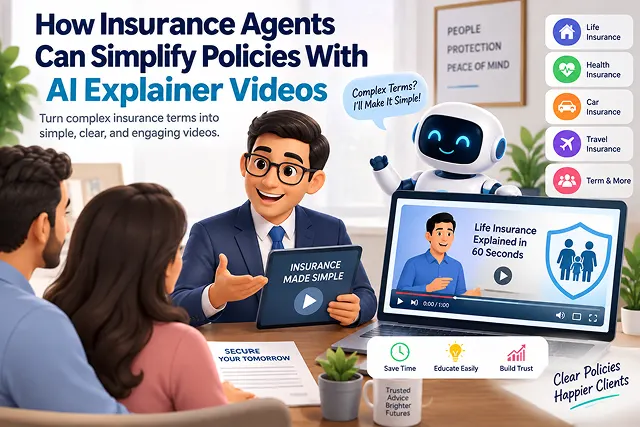
Insurance agreements are famous for their complicated legal clauses, tricky addenda, and confusing deductible levels. For independent agents and brokers, having to clarify all of these details hundreds of times for each client is frustrating and prolongs the binding speed of the policy and increases post-sale support calls.
By utilizing AI explainer video systems—combining synthetic digital twins, dynamic screen-recording overlays, and automatic policy-to-script LLM conversion—agents can adapt a 40-page PDF policy addendum into a personalized video summary that only takes 90 seconds for the client to watch.
Above-the-Fold Breakdown: Traditional Policy Delivery vs. AI Explainer Videos
Policy Delivery Optimization · Traditional PDFs & Phone Calls vs. AI-Driven Video Pipelines
| Policy Onboarding Dimension | Traditional Delivery (PDFs & Phone Calls) | AI-Driven Video Delivery Pipeline |
|---|---|---|
| Client Comprehension Rate | Low (Dense 20+ page PDF fine print) | High (Visual breakdown of deductibles & coverage) |
| Agent Time Spent per Client | 30 to 45 minutes answering basic coverage FAQs | 3 minutes to send an automated video breakdown |
| Production Cost & Time | Unfeasible to record custom videos manually | 5 to 10 minutes to generate using AI web tools |
| Quote-to-Close Conversion | Standard email follow-ups with attachments | Significant lift with personalized video walkthroughs |
| Claims Dispute Prevention | Frequent ("I thought I was covered for that") | Clear visual audit trail of covered perils vs. exclusions |
| Multilingual Support | Limited by agency staff language fluency | Instant voice-cloned dubbing into 50+ languages |
1. Core Architectural Framework: The Policy Simplification Pipeline
Converting an intricate insurance contract into an accessible video breakdown relies on a 4-stage data pipeline:
[40-Page Policy Schedule PDF] ➔ [LLM Extraction & Plain-English Translation]
                                                                  │
                                                                  ▼
[Customer Email / WhatsApp Link] ◄─── [Personalized AI Avatar Render] ◄─── [SSML Timing & Visual Motion Anchors]
1. Document Extraction & Translation Layer
The underwriting document is parsed using an LLM conditioned to isolate four high-priority variables:
- Deductible threshold: This is the limit on how much the insured must pay before coverage kicks in.
- Coverage Scope versus Major Exclusions: This provides information on areas that will be covered in a claim (e.g., wind damage) and areas that will need a separate rider (e.g., subterranean groundwater/flooding).
- Claim Filing Trigger: The process that must be followed within 48 hours of the incident in question.
- Premium Payment Schedule: A schedule of deadlines, automatic payments, and grace periods.
2. Conversational Digital Twin (Agent Avatar)
- Rather than using generic stock narrators, agents generate a trained digital clone of themselves (via HeyGen, Synthesia, or Tavus). When the client receives the proposal, they see their actual local agent walking them through the specific line items, preserving relational trust.
2. Operational Implementation Sequence for Agencies
Follow this sequential workflow to implement automated video quoting inside an independent agency:
1. Clone the Agent's Digital Persona
- Record a 2-minute studio calibration video (4K, 24 FPS, lapel mic) to generate the agency principal’s likeness and vocal clone across platforms like HeyGen or Tavus.
2. Connect Agency Management System (AMS) Webhooks
- Set up a webhook listener via Zapier or Make connecting your AMS (Applied Epic, HawkSoft, or EZLynx) so that changing a deal stage to "Quote Presented" automatically triggers the video rendering pipeline.
3. Dynamic Personalization Token Ingestion
- The engine dynamically injects customer name, deductible numbers, policy carrier logos, and specific coverage tables into the on-screen graphics alongside the avatar.
4. Automated Multi-Channel Dispatch
- Send the rendered video via personalized SMS and tracked email. Include a direct "Sign & Bind" button beneath the video player container.
Traditional Quoting vs. AI Explainer Workflows
Insurance Operations & Quoting Matrix · Static PDF Delivery vs. AI Video Policy Explainers
| Operational Vector | Traditional PDF & Email Delivery | AI Video Policy Explainer |
|---|---|---|
| Client Comprehension Rate | Low (< 25% read the full policy document). | High (75% — 85% video completion rate). |
| Time-to-Bind Policy | 4 to 10 days (Multiple follow-up phone calls). | 24 to 48 Hours (Fewer friction points). |
| Post-Purchase Dispute Rate | Frequent ("I didn't know flood wasn't covered"). | Minimal (Exclusions explicitly visualized on screen). |
| Personalization Scalability | Low (Generic templated email PDFs). | High (Dynamic CRM-driven video tokenization). |
| Agent Time Spent Explaining | 30 to 45 minutes per prospect. | Zero marginal time (Automated video dispatch). |
Request A Custom AI Video
Tell us what you're trying to create and we'll point you to the right tool — or help you set it up.
3. Mandatory Legal Disclosures & Compliance Regulations
Using artificial intelligence for automated financial advisory or insurance description creates regulatory compliance issues. There are several ways to protect your brokerage from enforcing the following compliance measures:
The Statutory Summary Disclaimer: Place an explicit, high-contrast text footer below the video player container:
"Legal Notice: This automated video provides a high-level educational summary of proposed policy terms. It does not replace, modify, or supersede the official terms, conditions, limitations, or exclusions contained in your underwritten policy declarations and jacket. Coverage is subject to carrier underwriting approval."
The "Zero-PII" Public URL Policy: Never expose a policyholder's Social Security Number, Date of Birth, or Drivers License Number inside the video voiceover or unencrypted video metadata. Video tokens should reference internal CRM hashes or sanitized customer IDs.
Archiving of Audit Trail: There are regulations of SEC and FINRA as well as local insurance laws regarding the storage of marketing materials provided to customers. To fulfill such regulatory requirements, clients will have to arrange immodestly for archiving of raw files and videos of marketing material (for instance, MP4 videos and documents in the format of plain text) for at least five years.
4. End-to-End Enterprise Production Pipeline
Deploying this system within an independent insurance agency follows a four-step automated sequence:
1. AMS Stage Change & Data Extraction
- An agent updates an account in Applied Epic or HawkSoft to "Quote Delivered". An outgoing webhook fires containing client demographic fields, carrier PDFs, and calculated premiums.
2. SSML Scripting & Viseme Rendering
- A Python microservice transforms the underwriting parameters into an SSML script containing explicit legal exclusions and dispatches a render request to the agent's digital avatar profile in HeyGen.
3. Remotion / FFmpeg Split-Screen Merge
- The rendered avatar video is passed to a headless Remotion Node.js container on AWS ECS, combining the speaker video with animated right-hand coverage cards, deductible callouts, and background audio ducking.
4. Multi-Channel Twilio Dispatch & Analytics
- The completed video is saved to an encrypted, client-specific portal. Twilio sends the access token via SMS and WhatsApp. When the client finishes the video, an alert is sent back to the agent's CRM with a prompt to bind the policy.
AI Video for Insurance Agents
Demystify policy jargon, automate claims walkthroughs, and boost policy renewals with AI explainer videos.
Most policyholders rarely read through 30-page dense legal policy booklets, resulting in confusion during claims and longer sales cycles. AI explainer videos condense complex coverages, deductibles, and exclusions into simple 60-to-90-second visual summaries, improving client comprehension, building trust, and speeding up policy close rates.
A practical, agency-ready toolkit includes: Claude or ChatGPT (to translate contractual policy language into simple client-facing scripts), HeyGen or Synthesia (to deploy professional virtual agent avatars that deliver the walkthrough), Vyond or Renderforest (for 2D animated claim scenarios), and CapCut (for branded captions and compliance text overlays).
By recording a single 2-to-3-minute video of themselves in professional attire against a clean backdrop, an agent can create a custom photorealistic AI avatar and cloned voice profile. Once calibrated, the agent simply inputs new policy text, and their digital twin presents the walkthrough with natural eye contact and hand gestures—without needing to record in front of a camera again.
Using dynamic variable mapping via CRM automation (e.g., Zapier paired with Tavus or HeyGen API), agents can automatically generate customized video messages. The AI avatar addresses the policyholder by their first name, cites their specific vehicle or property, and references their exact deductible and premium values when sending policy onboarding emails.
The highest-performing formats are: 1. "Deductible vs. Out-of-Pocket Max" visual breakdowns, 2. Step-by-step claims filing tutorials (e.g., how to document car accident damage), 3. Umbrella policy coverage explanations, and 4. Annual renewal updates highlighting changes in inflation-adjusted property replacement values.
Compliance requires two standard safeguards: persistent disclaimer banners (e.g., "This video is a summary; refer to formal policy terms for exact coverage language") and strict script approval through the carrier or agency compliance officer. Storing time-stamped script approval logs ensures a clean regulatory audit trail.
Using multilingual voice cloning and lip-syncing platforms (such as ElevenLabs and HeyGen), agents can translate their policy briefings into Spanish, Mandarin, Tagalog, or Vietnamese in minutes. The agent’s avatar delivers the presentation fluently with matching lip sync, eliminating language barriers and expanding reach to diverse immigrant and non-native speaking communities.
Following natural disasters, winter freezes, or major regional storm fronts, agencies are flooded with identical questions regarding deductibles and claim procedures. Embedding a 2-minute AI video link in initial claim receipt SMS messages directly answers routine questions, reducing repetitive inbound support calls by 30% to 50% and freeing adjusters to focus on urgent claims.
Premium rate adjustments are the leading cause of client turnover during renewal periods. Sending an automated, personalized AI video 45 days prior to renewal explaining market trends, home valuation shifts, and bundling opportunities proactively addresses client price sensitivity before they shop competitors, boosting renewal retention rates.
Follow this proven 3-Step Agency Production Pipeline: First, paste an existing complex policy rider or claim checklist into an LLM and prompt it for a friendly 75-second conversational script. Second, generate the video walkthrough using your cloned agent avatar in HeyGen or Synthesia, overlaying key dollar figures visually. Third, add compliance disclaimers and auto-captions in CapCut, then embed the finalized link directly into client onboarding emails.
Ready to try Skora AI?
Transform your ideas into cinematic video in seconds.